Watch and schedule updates
Keep reviewed sensors, routines and prompts current with their enabled and refresh settings in bf.yaml; timing and health says when each one is due and how failures retry. Start inside your brain.
| You want to… | Use |
|---|---|
| Run due programs while a terminal is open | bf watch |
| Observe another collector | bf status --watch; it executes nothing. |
| Run unattended on a running machine | bf schedule, then install the generated systemd, launchd or cron files. |
BF installs no background service. First run your programs once by hand.
Check before scheduling
bf update --dry-run    # list due work; run nothing
bf update              # run due sensors, then routines, then prompts
bf status --check
The dry run lists due programs with their windows, and names under manual the enabled programs with refresh: 0 that updates skip. A healthy bf status --check exits 0. Set enabled: false to stop a program, or refresh: 0 to keep it manual, as sensors and routines are by default. Keep CI for offline bf validate and bf eval; for a shared source, designate one collecting laptop.
Watch collection
bf watch
Watch runs due sensors and routines at once, then checks again 60 seconds after each completed cycle; --interval SECONDS changes that. Due prompts run in a second process beside that cycle, so a long agent run never delays collection; the dashboard marks them with @. It can contact providers. A failed program retries after the failure backoff. Closing watch stops its collection.
The dashboard shows each program's state, last success, next due time, returned items and record changes. never means no success on this machine, such as a sensor that only backfilled older windows; failed means the last attempt failed. Items counts the records the last completed collection returned, even a backfill, not the stored total. Manual and disabled programs stay visible without running. Use bf status --check for full health.
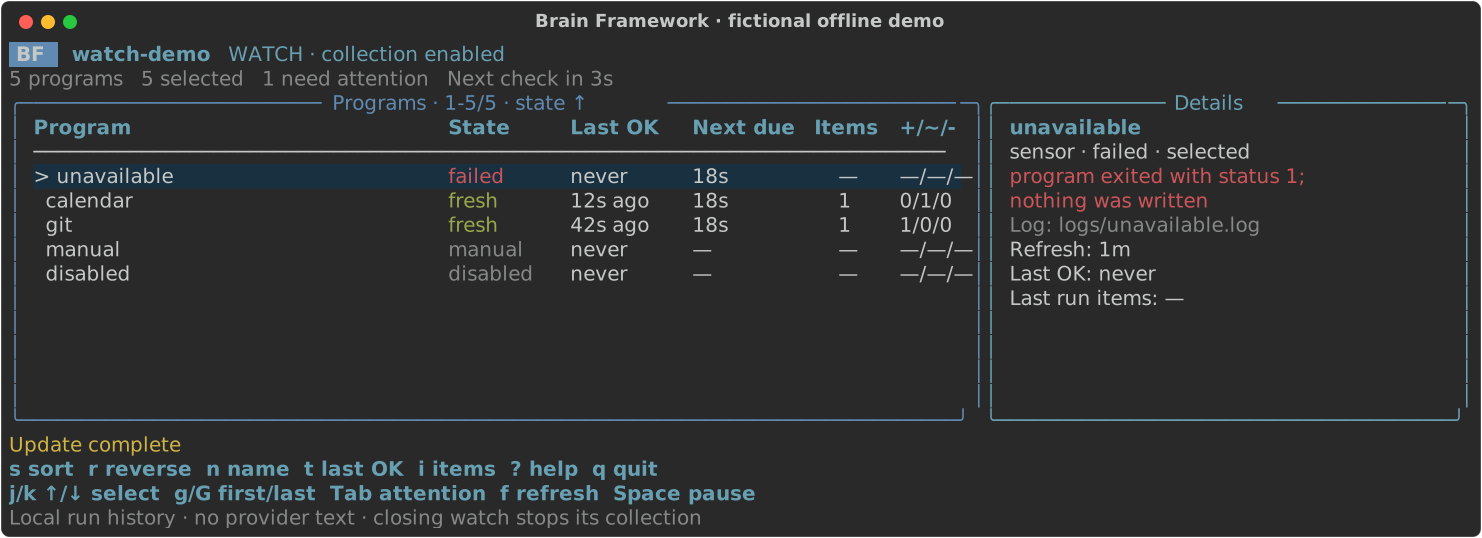
This is the fictional offline watch demo, sorted by state: unavailable failed, calendar updated its record, git added one, and the manual and disabled sensors stay idle.
| Key | Effect |
|---|---|
j / k, arrows |
Select a program and show its details, including its log and latest action. |
| Tab | Show only programs needing attention: failed, never collected or due. |
f (or u) |
Reload bf.yaml and check due work now; queues one check during an update. |
| Space | Pause or resume future checks; an active update finishes. |
? |
Toggle the guide: every key, sort field and count explained. |
q |
Cancel any active update and quit. Ctrl-C or closing the terminal exits 130. |
Press f after adding a reviewed program to bf.yaml: its row appears and it runs if due. Refresh respects selectors, pause, refresh and failure backoff. When bf.yaml becomes invalid, or stops declaring a program you selected, the message line shows BF's diagnostic, such as unknown sensor git; check names in bf.yaml, and nothing runs until you fix it. Changes to the watch preferences need a restart.
Sort the dashboard
s cycles the sort field, n, t and i sort by name, last success and items, and r reverses. The panel title shows the field and direction, such as Programs · 1-5/5 · items ↓. Unknown values sort last, and ties stay alphabetical. The selected program stays selected as rows move. Sorting lasts for the session and changes nothing in bf.yaml; it also works in bf status --watch.
Terminal and observation
Use a color terminal of at least 80 columns by 24 rows; from 120 columns, details appear beside the table. Colors follow NO_COLOR, and labels stay meaningful without color.
bf status --watch   # observe only; never runs programs
bf watch --json     # run due work and stream JSON Lines
Observation shows local history alongside a native scheduler. It offers u to reread and has no pause. Without an interactive terminal, it fails and suggests bf status.
bf watch --json writes a snapshot every poll_interval with brain, running, prompting (a prompt process is active), message and programs, one row per program. A row's status is the dashboard state: failed, never, due, fresh, manual or disabled. Times show your local offset, and absent values are empty strings or null. The Row class defines every row field. A JSON watcher always collects and fails while another watcher owns the brain.
Watch preferences
The watch section is optional, and an empty one keeps the defaults. By default, watch checks due work every 60 seconds, rereads local history every 2 seconds and alerts on failures and recovery. For a quieter session:
bf watch --interval 300 --notify off
To keep those preferences, add a watch section to bf.yaml:
# https://fmind.github.io/brain-framework/docs/schedule/#watch-preferences
watch:
  interval: 300
  notifications: off
| Setting | Default | Accepted values |
|---|---|---|
interval |
60 | Seconds between checks for due work, 5–86400. |
poll_interval |
2 | Seconds between history reads and JSON snapshots, 0.2–60. |
notifications |
failure |
off, failure, success or all. |
notification_cooldown |
300 | Seconds between alerts, 0–86400. |
Command-line options override bf.yaml, then defaults apply. Every command loading bf.yaml validates the section, even when an option overrides it. failure alerts on new failures and recoveries; success on recoveries and on cycles that completed work, even while another program keeps failing; all on all three. Alerts never name sources or quote provider text. Desktop alerts need osascript on macOS, or notify-send or gdbus on Linux; a delivery failure warns once and collection continues.
Select programs
Repeat --sensor, --routine and --prompt on update, watch or schedule:
bf update --sensor git-commits --dry-run
bf watch --sensor git-commits --routine weekly-review
bf schedule --sensor git-commits --name git-only
With no selector, every configured program is eligible, including programs added later. bf update --kind KIND, repeatable, keeps only sensors, routines or prompts, as watch does for its prompt process. With any selector, only the named programs are. An unknown name fails before anything runs and suggests a close one. Selectors never force a disabled or manual program to run.
Generate a native schedule
bf schedule --every 15 --output ~/.config/bf-schedules
The reply lists the generated files, the written paths and literal argument lists to install, check the status of and remove the job. BF runs none of them. Without --output, the reply previews the files and warns that nothing was written; its install commands copy from ~/.config/bf-schedules, where the suggested rerun writes them. A relative --output resolves against the brain folder. Differing existing files are kept and generation fails, so your edits survive.
The files hold home and brain paths and the PATH that bf schedule runs with: keep them out of a shared brain's Git history. Credentials and other environment variables are not copied. Sensors and routines find commands such as uv through that PATH: when it lists version-specific tool folders, such as those of mise, asdf, pyenv or nvm, put stable shims in their place or regenerate the schedule after upgrading those tools. In a brain that pins its runtime, generate them with uv run --locked bf schedule ..., so jobs and nested bf calls use the pinned release.
| Option or default | Meaning |
|---|---|
--backend auto |
launchd on macOS; systemd on Linux when systemctl is present; otherwise cron. |
--every 15 |
Check every 15 minutes; the interval must divide an hour: 1, 2, 3, 4, 5, 6, 10, 12, 15, 20, 30 or 60. |
--name update |
Job name; use different names for different selections. |
--executable PATH |
The installed bf; the default sits beside the running Python. Regenerate if it moves. |
Review the programs and the generated environment, then follow the returned commands. For cron, copy the single job line into crontab -e; never run crontab FILE, which replaces your existing jobs. Check systemd files with systemd-analyze --user verify and launchd files with plutil -lint before installing.
Scheduler behavior and host lifecycle
Systemd timers run a trigger missed while the machine was off once after it starts again (Persistent=true), and add up to 30 seconds of jitter. LaunchAgents coalesce triggers missed during sleep into one run, but do not replay those missed while powered off. Cron skips missed triggers. Stopping a job allows 60 seconds for an update to roll back an interrupted record write. Each program's timeout bounds its run; there is no total job timeout.
Use a running systemd user manager on Linux and a logged-in user's LaunchAgent on macOS. ChromeOS stops its Linux environment at logout, and WSL needs a running distribution. See the ChromeOS lifecycle, WSL systemd and Apple scheduling guides.
Collector ownership
Use one execution owner per program. A second interactive bf watch on the same brain observes the first instead of collecting, and does not take over when it exits. Timers cannot be detected by watch: use bf status --watch while a timer owns collection.
Updates of one brain run one at a time. A second update waits up to 10 minutes, then computes its own due list, or fails with another update is still active. bf collect keeps its own lock per sensor. Removing a systemd or launchd job with the returned commands also stops an active update; removing a cron line stops future runs only.
Timing and health
A program is due when it is enabled, has a nonzero refresh and has not succeeded on this machine within that many seconds. refresh defaults to 0 for sensors and routines, which keeps them manual: only bf collect or bf run starts them. Prompts default to refresh: 1800: bf watch, bf update and schedules run a prompt every 30 minutes unless you set refresh: 0.
A failure lets the other programs continue and makes bf update exit 1. The failed program retries 1 minute later, then after 2, 4, 8… minutes per consecutive failure, never waiting longer than its refresh; a success resets the delay. bf collect and bf run always run at once, and a direct prompt run leaves the schedule unchanged. Each run appends to the program's log, logs/NAME.log in the brain, as processes and logs describes.
A scheduled program is fresh when it succeeded on this machine within twice its refresh, overdue when it has succeeded but not within that time, and never when it has no local success. A sensor succeeds only with a collection reaching the moment it runs: one that only backfilled older windows stays never. A program with refresh: 0 is manual; a disabled program or historical source is unknown. bf status --check exits 1 for an enabled scheduled program that is overdue, never succeeded, last failed or, for a source, fell silent. Run it on the collecting machine: run history is local, even when records are shared.
Silent sources
Freshness proves that a sensor succeeded, not that it found anything: after a changed filter, an expired account or a provider change, a sensor can keep succeeding with nothing new. Give a source that always brings news within a known delay a silent_after, in seconds:
# https://fmind.github.io/brain-framework/docs/sensors/
sensors:
  mail:
    command: [sensors/gmail-headers.py, "{{start}}", "{{end}}"]
    refresh: 3600
    silent_after: 172800 # new mail arrives at least every two days
bf status gives each source's changed: the newest time this brain gained a new or changed record of it, whatever the records' event times. An enabled scheduled source whose changed is older than its silent_after is "silent": true, joins attention and the home page, and fails bf status --check, while its freshness stays as it is. Collecting a new or changed record ends the silence. A source without any record is never silent: its count already shows it. Set silent_after above the longest quiet spell the source really has, such as a weekend for a daily feed.
Choose a timer interval shorter than the smallest nonzero refresh: bf schedule warns, naming that program, when --every reaches it, and so does bf watch for its interval, in the dashboard summary and guide or as one bf: line on stderr with --json. With an hourly sensor and a 15-minute timer, a check 59 minutes after the last success skips the sensor, and the next check, at 74 minutes, runs it. A success timestamp in the future, after a clock correction, makes the program due at once. Long pauses catch up at most 30 days.